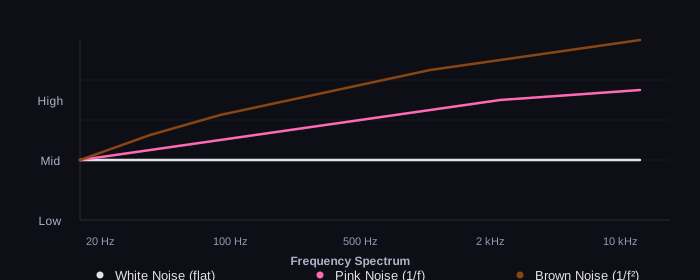
If you've spent any time searching for sleep sounds online, you've encountered the noise color spectrum: white noise, pink noise, brown noise. They get thrown around interchangeably by most sleep apps and YouTube channels, as if they're all just "background noise" with different branding. They're not. Each color represents a fundamentally different frequency distribution, and your brain responds to them in measurably different ways. Choosing the right one can be the difference between masking sound effectively and actually accelerating sleep onset.
This guide breaks down the real science behind each noise color, explains who each one works best for, and helps you figure out which to use tonight | not next week after more research.
What "noise color" actually means
Noise color refers to the power spectral density of a sound | how energy is distributed across frequencies. Think of it like light: white light contains all visible wavelengths equally, and white noise contains all audible frequencies at equal intensity. Change the distribution, and you get different colors with different properties.
This isn't marketing. It's signal processing, and it has direct implications for how your auditory cortex processes the sound while you're trying to sleep. The frequency profile determines whether the noise feels sharp, warm, harsh, or enveloping | and those subjective differences map to real neurological responses.
White noise: the classic all-frequency mask
What it is: Equal power across all frequencies (20 Hz to 20,000 Hz). Every tone from deep bass to high treble plays at the same intensity.
What it sounds like: TV static, a hissing radiator, an untuned radio. It has a distinct "shhh" quality that many people find immediately recognizable.
The science: White noise is the most studied sleep sound in research literature. Its primary mechanism is auditory masking - it raises the baseline noise floor so that sudden environmental sounds (door slams, car horns, snoring partners) produce less contrast against the background. Your brainstem's arousal response triggers on change, not volume. By flattening the acoustic environment, white noise reduces the number of arousal events per sleep cycle.
Who it works best for: People in noisy environments - thin apartment walls, street-facing bedrooms, partners who snore. If your primary sleep problem is being woken by sudden sounds, white noise is the most efficient masking solution because it covers the full frequency spectrum.
The downside: Some people find pure white noise harsh or fatiguing over extended periods. The equal high-frequency energy can feel "bright" or aggressive, especially at higher volumes. If you're sensitive to treble or find white noise too sharp, you may not be able to sustain it through a full night without ear fatigue.
Pink noise: the frequency-balanced alternative
What it is: Power decreases proportionally as frequency increases. Every octave has equal energy (as opposed to every frequency having equal energy in white noise). Technically, it falls off at 3 dB per octave.
What it sounds like: Steady rainfall, wind through trees, a distant waterfall. More natural and "warmer" than white noise because the harsh high frequencies are tamed.
The science: Pink noise matches many patterns found in nature, which may explain why the brain tends to habituate to it more easily. A widely cited study published in Frontiers in Human Neuroscience found that pink noise played during sleep increased the percentage of stable sleep and improved memory consolidation compared to silence. The theory is that the rhythmic, consistent spectral pattern of pink noise synchronizes with the brain's slow oscillations during deep sleep - essentially providing a gentle timing signal that the brain locks onto.
Who it works best for: Light sleepers who find white noise too aggressive, anyone who prefers natural-sounding environments, and people who want potential memory and deep sleep benefits beyond simple masking. Pink noise is often the best starting point for people new to sleep sounds.
The downside: Because the high frequencies are reduced, pink noise provides less masking for high-pitched sounds like smoke alarms, phone notifications, or certain speech frequencies. If your noise environment includes a lot of treble-range disruptions, pink noise might not mask them as effectively as white noise.
Brown noise: the deep rumble that overthinkers love
What it is: Power drops off much more steeply - 6 dB per octave. This means the sound is dominated by low-frequency energy with very little high-frequency content. Also called "red noise" or Brownian noise (named after Robert Brown and Brownian motion, not the color).
What it sounds like: A deep, rumbling drone. Like standing near a large waterfall, the low roar of a distant thunderstorm, or the hum of an airplane cabin. It's the "deepest" sounding of the three noise colors.
The science: Brown noise has less formal sleep research behind it than pink or white noise, but it has developed a massive following - particularly among people with ADHD, anxiety, and chronic overthinking. The mechanism appears to be related to its enveloping quality: the dominant low frequencies create a sense of being wrapped in sound, which many people report as deeply calming. Low-frequency sounds have been shown to activate the parasympathetic nervous system more effectively than high-frequency sounds, which may promote the relaxation response needed for sleep onset.
Who it works best for: Overthinkers, people with anxiety or racing thoughts at bedtime, ADHD brains that need a strong auditory anchor to quiet internal monologue, and anyone who finds white and pink noise too "thin" or insufficiently immersive. If your brain tends to chew on problems at night and you need something that genuinely drowns out your internal voice, brown noise is often the winner.
The downside: Brown noise provides almost zero masking for high-frequency sounds. If someone's phone buzzes or a bird chirps at 4 AM, brown noise won't cover it. It's best paired with other sounds if your environment includes a mix of low and high-frequency disruptions.
The comparison nobody else gives you
Masking breadth: White > Pink > Brown. White noise covers the full spectrum. Pink covers most of it with reduced highs. Brown only covers lows.
Perceived comfort: Brown > Pink > White (for most people). Brown feels warm and immersive. Pink feels natural. White can feel sharp.
Deep sleep potential: Pink has the most research supporting sleep stage benefits. Brown has the strongest anecdotal following. White is proven for masking but less studied for sleep quality improvement.
For ADHD/anxiety: Brown wins, overwhelmingly. The depth of the sound creates a "noise cocoon" effect that helps quiet hyperactive default mode networks.
For noisy environments: White wins for broadband masking. Consider layering brown + white if you need both immersion and full-spectrum coverage.
The real answer: layer them
The best approach for most people isn't choosing one noise color - it's combining them. A brown noise base provides the deep, enveloping foundation that calms your nervous system, while a touch of pink or white noise layered on top covers the higher frequencies that brown noise misses. This creates a more complete acoustic shield that both relaxes you and protects you from environmental disruptions. If you've found yourself dependent on one particular noise type and can't sleep without it, that's actually a positive sign your nervous system has learned the pattern - dive deeper into why that dependency forms and how to use it to your advantage.
This is why sound mixing matters more than any single noise type. Being able to blend multiple sounds at different volumes lets you build a custom acoustic profile that matches your specific brain, your specific environment, and your specific sleep challenges. A static "brown noise" loop from a free YouTube video can't do that.
How IOn Sleep handles this
IOn Sleep includes white, pink, and brown noise as individual tracks, but the real power is in the mixer. You can layer up to 3 sounds simultaneously with independent volume control - so you can run brown noise at 70% with pink noise at 30% and a rain overlay at 40%, dialing in exactly the profile your brain responds to. Add binaural beats in the delta or theta range and you've built a multi-layer sleep onset system that addresses both your acoustic environment and your brainwave state.
All sounds work offline, no account required, and no data collected. The free tier includes brown, white, and pink noise. Premium unlocks the full 20+ sound library, mixing, and IOn Flow - our dynamic frequency transition track designed for optimal sleep onset. Try it free and find out which noise color actually works for your brain.