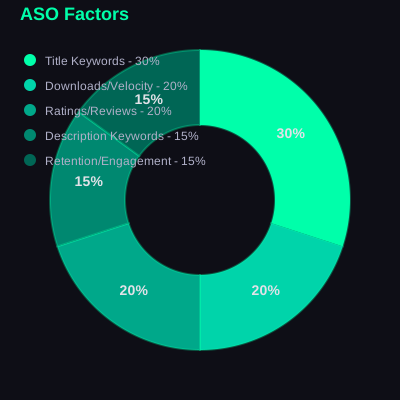
App Store Optimization is the single highest-leverage growth activity for most Android developers, and most of them are doing it wrong | or not doing it at all. If you've published an app to Google Play and wondered why nobody's finding it, the answer is almost certainly in your listing, not your marketing budget. ASO is how Google decides which apps to show when someone searches, and in 2026, the algorithm is more sophisticated than ever.
This guide covers everything that actually matters for Google Play ASO right now | the ranking factors, the common mistakes, and the specific optimizations that move the needle. No vague advice, no "just make a good app" platitudes. Concrete, actionable steps.
What is ASO and why should you care?
App Store Optimization is the process of improving your app's visibility in the Play Store's search results and browse recommendations. Think of it as SEO for apps. When someone searches "sleep sounds" on Google Play, ASO determines whether your app shows up on page one or page ten | and the difference in install rates between those positions is staggering. Research consistently shows that the top 3 search results capture the vast majority of organic installs for any given keyword.
For indie developers and small teams, ASO is especially critical because it's free. Unlike paid acquisition (where you're competing against companies with six-figure ad budgets), ASO lets you compete on the quality and relevance of your listing. A well-optimized listing from a solo developer can outrank a poorly optimized one from a large studio.
The ranking factors that actually matter
1. App title (30 characters max)
Your app title is the single most heavily weighted factor in Google Play search ranking. The algorithm gives significant priority to keywords that appear in your title. This means your title needs to accomplish two things simultaneously: communicate your brand and include your primary target keyword.
The best titles follow the pattern: Brand Name: Primary Keyword. For example, "IOn Sleep: Alarm & White Noise" tells both Google and users what the app does while establishing brand identity. The worst titles are either pure brand names with no keywords ("Sleepify Pro") or pure keyword stuffing with no brand ("Best Sleep Sounds White Noise Alarm Free 2026").
2. Short description (80 characters)
The short description appears directly below your title in search results and is the second most important text field for ASO. This is your elevator pitch - 80 characters to convince both the algorithm and the human scanning results to go deeper. Include your secondary keywords here naturally, not as a comma-separated list.
3. Full description (4,000 characters)
Google's algorithm parses your full description for keyword relevance, but it's also smart enough to detect keyword stuffing. The optimal approach is to mention your primary keywords 3–5 times naturally throughout the description, use secondary keywords 1–2 times each, and structure the description with clear feature sections that communicate value. The first 1–2 sentences are visible before the "Read more" expand, so lead with your strongest pitch.
4. Visual assets
Your icon, feature graphic, and screenshots don't directly affect search ranking, but they dramatically affect your conversion rate - which indirectly affects ranking. Google tracks your listing's conversion rate (impressions → installs) and uses it as a quality signal. A listing that converts at 30% will rank higher over time than one converting at 10%, even with identical keywords. Professional screenshots with clear value propositions are not optional - they're a ranking factor in disguise.
5. Ratings and reviews
Higher average ratings correlate with higher search rankings, and the volume and recency of reviews matter too. An app with 500 recent 4.5-star reviews will outrank an app with 50 stale 4.8-star reviews. Google wants to surface apps that current users are actively enjoying, not apps that were good three years ago. This means maintaining quality and responding to negative reviews isn't just customer service - it's ASO.
6. Install velocity and retention
Google tracks how quickly your app gains new installs (velocity) and how many users keep it installed (retention). A sudden spike in installs signals relevance. High uninstall rates signal the opposite. These behavioral signals are harder to optimize directly, but they reinforce why everything else matters - a great listing drives installs, and a great app drives retention, and together they create a positive feedback loop in the algorithm.
Common ASO mistakes (and how to fix them)
Mistake 1: No keywords in the title. If your title is just your brand name, you're invisible for every keyword search. Add your primary keyword after a colon or dash.
Mistake 2: Description keyword stuffing. Repeating "best sleep app" 20 times doesn't help - it triggers Google's spam detection and tanks your ranking. Use keywords naturally in sentences that humans would actually read.
Mistake 3: Low-effort screenshots. Raw phone screenshots with no context, no text overlays, and no value propositions kill conversion rates. Your screenshots should function as a visual sales pitch - each one communicating a specific feature or benefit.
Mistake 4: Ignoring the short description. Many developers leave the short description as an afterthought. It's your second most important text field. Treat it like ad copy: concise, keyword-rich, and compelling.
Mistake 5: Never updating the listing. ASO isn't a one-time setup. Keywords that worked six months ago may have new competition. Seasonal trends change. Your feature set evolves. Revisit your listing at least quarterly.
Measuring your ASO performance
You can't improve what you don't measure. An ASO score gives you a single number that represents how well-optimized your listing is across all the factors that matter. The best ASO scoring systems break down into categories - title optimization, description quality, keyword coverage, visual asset completeness, and metadata health - so you can see exactly where you're strong and where you're losing points.
Most indie developers skip measurement entirely and rely on gut feeling. That's like trying to improve your marathon time without ever looking at a stopwatch. Even a basic ASO audit will reveal opportunities you didn't know you were missing. Once you've optimized your baseline listing, the next step is to test variations systematically. Our guide on A/B testing your Google Play listing walks through how to run proper experiments on different elements of your store presence to drive real download growth.
How IOn Emit helps with ASO
IOn Emit includes a built-in 100-point ASO scoring system that evaluates your listing across 12 criteria in real time. As you edit your title, descriptions, and assets in the listing editor, your score updates live - so you can see the impact of every change before you publish. The score breaks down into category weights: App Name (15 points), Short Description (15), Full Description (15), Keywords (15), Visual Assets (22), and Metadata (18).
Beyond scoring, IOn Emit's keyword analytics show you keyword density, stuffing warnings, and title keyword opportunities. The AI description generator produces ASO-optimized copy with your target keywords woven in naturally. And the AI-powered description tools mean you don't need to be a copywriter to write descriptions that both rank and convert.
The free tier includes the full ASO scoring and keyword analytics. Pro adds semantic keyword clustering, search visibility simulation, and conversion psychology analysis for developers who want to go deeper. Download free and see your ASO score in minutes.